
Play Dominoes Online vs AI
How to Play Dominoes
Play two-player Double-Six Draw Dominoes here: seven tiles each, with two left untouched in the boneyard. Black may open with any tile. After that, play to an open end; if nothing fits, draw until something does or only the two reserved tiles remain. Empty your hand first, or hold fewer pips in a block, and you win. Pick an AI level and a seat, then start.
What Dominoes Is
A domino is a rectangle split in two, each half showing zero to six pips. This table uses the double-six set: twenty-eight unique tiles, from 0-0 to 6-6. It is not mahjong, and it is not the tumbling-block toy. The job is to grow one shared chain.
Matching-pip tiles are usually traced to China. By the Song period, bone and ivory tablets already stood for a throw of two dice. Chinese sets later became games such as tianjiu: typically thirty-two tiles, with duplicates and some red faces. In the eighteenth century the tiles reached Italy, took the name domino, and spread through French and British parlors into the Western double-six of twenty-eight unique pairings. Local games branched from there: Block, Draw, All Fives, Mexican Train. The sitting above is the two-player Draw game that became the English-speaking default.
Each side starts with seven tiles; two stay in the boneyard. Black may open with any tile. After that you match an open end, or draw until you can. A legal play must be used. Empty your hand to win; if both sides pass, the lower pip total wins.
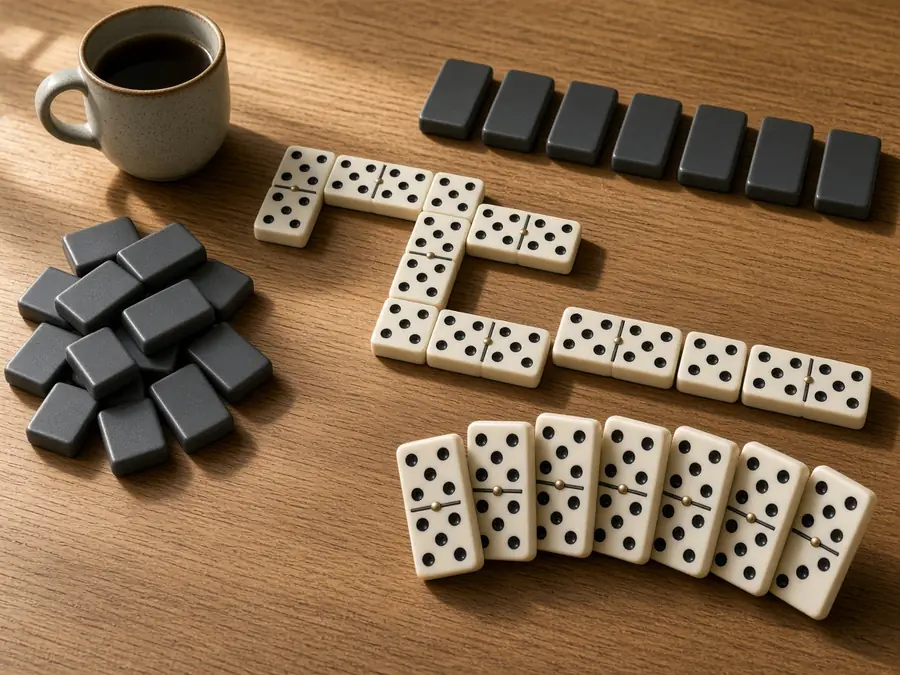
Match an Open End
The table is one chain, not a lattice of crossing points. Each end shows a pip value, and every play has to match one of them. The opening has no chain yet, so Black may start with any tile; both faces of that tile then become the two ends.
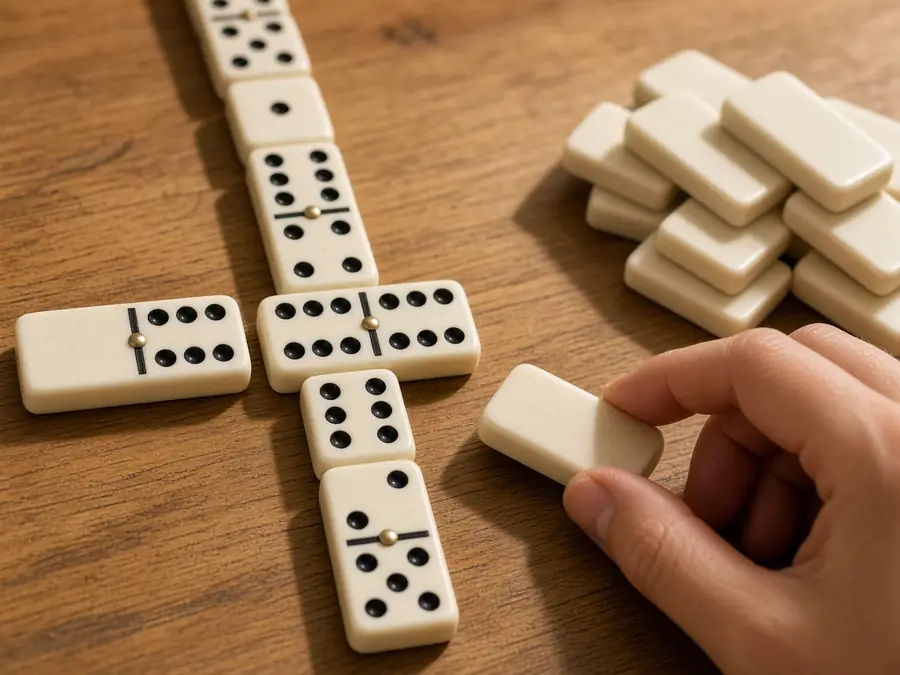
Draw Until You Can Play
When no tile in hand matches, draw from the boneyard until one does. Drawing does not pass the turn. Two tiles always stay in the boneyard: if you still cannot play after that, the turn passes and the other side moves.
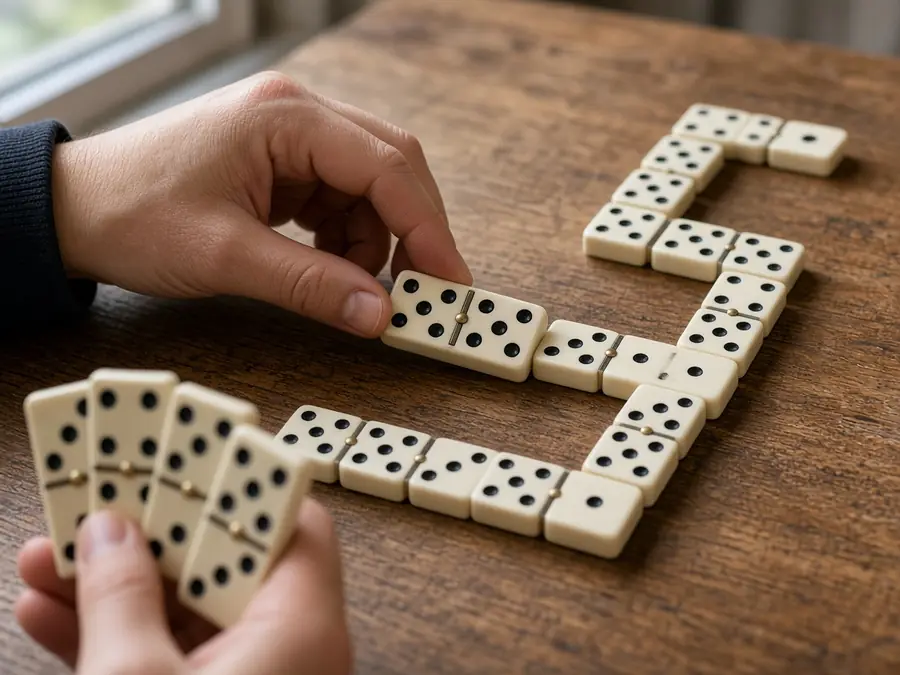
Hints Follow the Current AI Level
Pick a strength that matches the game, then sit Black or answer as White. Hints use the same search as that level. Undo takes back the last play together with the reply. After the game you can replay every draw, pass, and tile. All computation stays in the browser.
28tiles in a double-six set
7tiles dealt to each player
2tiles left in the boneyard
Pipsdecide a blocked game
Common questions
Which domino rules does this table use?
Two-player Double-Six Draw: twenty-eight tiles from 0-0 through 6-6, seven each, with the rest in the boneyard and two tiles always left unturned at the bottom. Black opens. While the chain is empty, the lead may play any tile; after that, every play must match the open pip on the left or right end. If nothing fits, draw until you can; when only those two reserved tiles remain and you still cannot play, you pass. Empty your hand to win; if both sides pass, the lower pip total wins.
How is this AI different from a quick web domino game?
The AI runs in a dedicated browser Worker, so the full position is not shipped to a remote server between your taps. The sidebar shows search progress for the level you picked. Hints use that same level; they are not a hidden stronger engine. Undo and replay stay on your device, which makes it easier to compare both open ends with what is still in your hand.
I have tiles in hand, so why will the chain not take my play?
Only one chain sits on the table, and each end shows one pip value. A tile must match one of those ends. If neither half of your tile matches, you cannot force it onto the line. While the boneyard still has drawable tiles, the table walks you through drawing; drawing does not pass the turn. The usual slip is watching only the left or right end, or treating a double like a free tile in the middle.
My tile fits both ends. Which one should I choose?
Both may be legal, but the end you close often matters more than the tile you picked. Each choice changes the open pip the other side will see next. When both ends work, this board asks you to tap the left or right of the chain. On a shared device, wait until the play is settled before you pass it across.
How should I use hints, undo, and replay without just copying the move?
Read both open ends yourself first, and say which tile you want and which pip you are trying to shut off. Then open the hint and compare. The hint follows your current AI strength. Undo returns you to the fork so you can try another line. Replay is for spotting when a big tile got stuck in your hand or when one end was closed off. Online rooms have no hints and no one-sided undo.
Can I play without signing up or installing anything?
Yes. Open the page on a phone or computer and start a game. There is no account, email, or password. Adding the site to your home screen is optional, and a full game works without installing an app.
Can I choose to play Black or White?
Against the AI, yes. As Black you play the opening tile. As White the AI moves first. Switching colour mid-game starts a fresh board; the chain does not carry over. In an online room you pick a seat when you create or join. On one shared device there is no colour picker: Black always opens and you take turns.
If I close the page or clear browser data, is this game still there?
Games against the AI and games on one shared device are saved in this browser, with separate saves for Black and for White. A refresh or a short break usually lets you continue. Clearing this site's data typically removes those in-progress games. Online rooms live on the server; reconnecting relies on the seat token the browser remembers, not a login.
If I invite a friend online, can I use hints and undo the way I can on the home page?
No. Once an online play is accepted, it is sent to the other player. There is no hint and no undo for a move that already synced. Either side may offer a draw, and it counts only if the other accepts. You can resign, or the host can close the room so the link expires. After a short disconnect, reopening the page usually returns you to the same seat.
How is two players on one device different from playing the AI?
Two people share one screen and pass it after each turn. You do not need a network, and neither side gets a hint. Undo and replay are still there, so you can pause and talk through why one end was chosen. Black opens every game; playing two games and swapping seats is the fair way to share the lead. The rules stay Draw: drawing keeps the turn, two tiles stay in reserve, and a block is decided by remaining pips.